
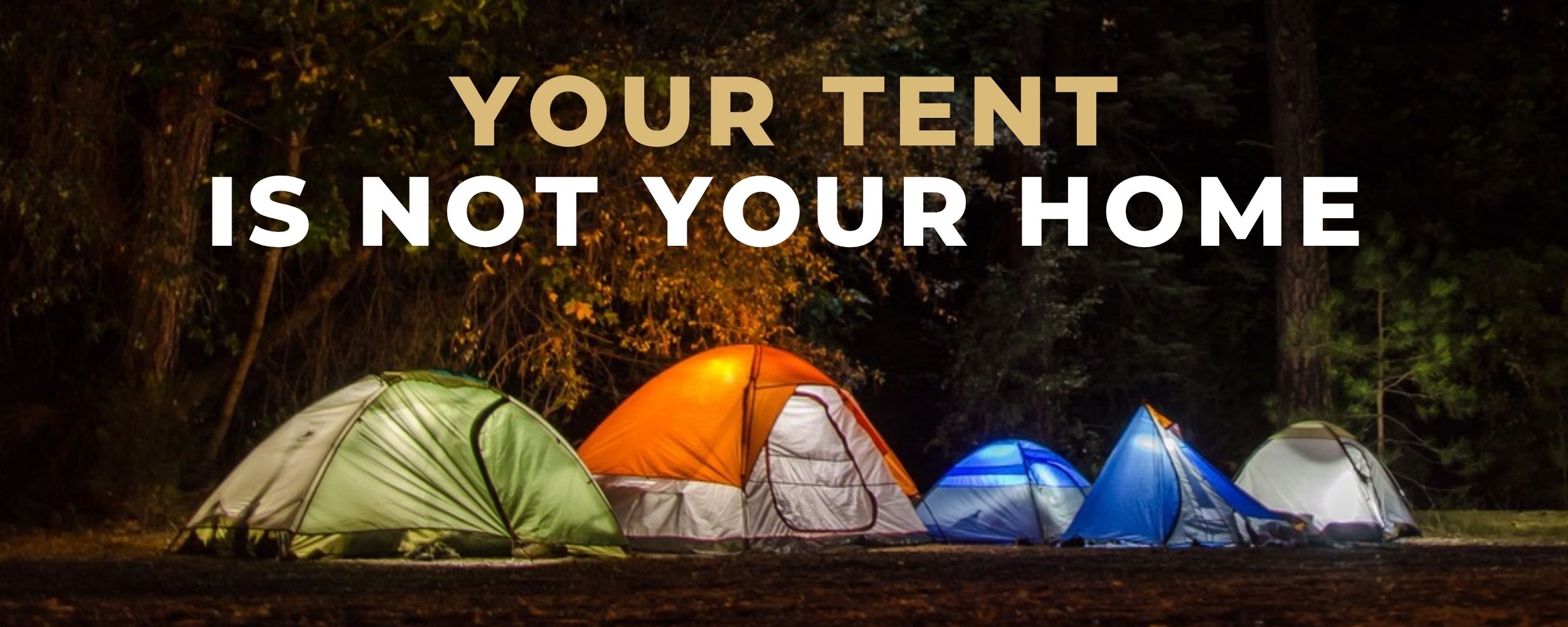
Your Tent Is Not Your Home

Friday Highlight – Your Tent Is Not Your Home
The week before I went to college, I went on a camping trip to the Boundary Waters. It was easily the longest and most intense camping trip I’d ever been on. We had to carry absolutely everything on our backs: food, clothing, canoes, tents, equipment for eating and sleeping, everything. And we moved to a new campsite every night, so we didn’t even get to settle down. That week, I learned the value of a good tent.
What makes a tent good? It has to be lightweight, waterproof, and windproof, but also breathable so it doesn’t get stuffy, and strong enough that it can handle wind and the rigors of backpack travel. It’s honestly asking a lot for a single pack item to accomplish all of that. But when it does, it’s wonderful. At its best, a tent can almost–almost–feel like being at home.
But not quite. We know intuitively that even staying in the best tent with the best gear isn’t the same as being home. The tent is temporary, the home is permanent. We see Paul using this exact metaphor in 2 Corinthians 5 to describe the difference between our earthly bodies (a tent) and our heavenly bodies (a home):
For we know that if the tent that is our earthly home is destroyed, we have a building from God, a house not made with hands, eternal in the heavens. For in this tent we groan, longing to put on our heavenly dwelling, if indeed by putting it on we may not be found naked. For while we are still in this tent, we groan, being burdened—not that we would be unclothed, but that we would be further clothed, so that what is mortal may be swallowed up by life.
(2 Corinthians 5:1–4)
Let’s lean into his metaphor a little bit.
The Bible frequently describes this life as a wilderness. We had a home in the Garden of Eden, but we lost it (Genesis 3). Since then, we’ve been on a centuries-long camping trip in the wilderness. And the tents we’re living in–our physical bodies–aren’t our true home. They aren’t permanent. When a bear comes sniffing around your campsite, you become startlingly aware of how thin and fragile your tent walls are. But that’s not really a tent’s purpose. It wasn’t designed to last forever, to stay put forever, or to keep out bears forever. It was designed to be lightweight, packable, easy to move, quick to tear down and set up, and keep you relatively warm and dry while you’re away from home. Again, the best tents are only a rough approximation of a house, and even the most seasoned backpackers start to long for home after weeks or months in a tent. Tents aren’t designed to be a long term housing solution. Houses are.
Houses are built on a firm foundation so they don’t move, which means they can have permanent fixtures like running water and electricity. They have sturdy walls to keep out bears, bugs, and burglars. They have a permanent address. And that’s how Paul describes our heavenly bodies: they’ll be more like a house than a tent. “In this tent we groan, longing to put on our heavenly dwelling.” Some of us have comfortable tents, others don’t. But everyone groans. Everyone gets tired of camping after a while. We all want to go home. To stop carrying this old tent around. To set it down on a permanent foundation. When Christ returns or calls you home (whichever comes first), your mortal body will be “swallowed up by life” and your tent will turn into the eternal dwelling it was made to be. But until then, the passage continues:
So we are always of good courage. We know that while we are at home in the body we are away from the Lord, for we walk by faith, not by sight. Yes, we are of good courage, and we would rather be away from the body and at home with the Lord. So whether we are at home or away, we make it our aim to please him.
(2 Corinthians 5:6–9)
We get to have courage, even in these fragile tents. As I found out when I woke up soaked on my Boundary Waters trip, tents don’t give much reason for courage. Houses do. And we who are in Christ know that we’re headed for a house–a sturdy, eternal dwelling made by God–and that makes all the difference. We don’t have to worry if someone threatens our tent, because we have a house waiting for us. That’s a kind of courage that doesn’t make sense to a world that thinks tents are all there is.
Fellow campers, pilgrims on the way, I know you’re longing for home. To lay your burden down on the doorstep and collapse into the loving arms of your Savior. But have courage. He who watches over you is faithful, he will not leave you, he will keep you, both in this temporary tent and in the eternal house to come (Psalm 121).