
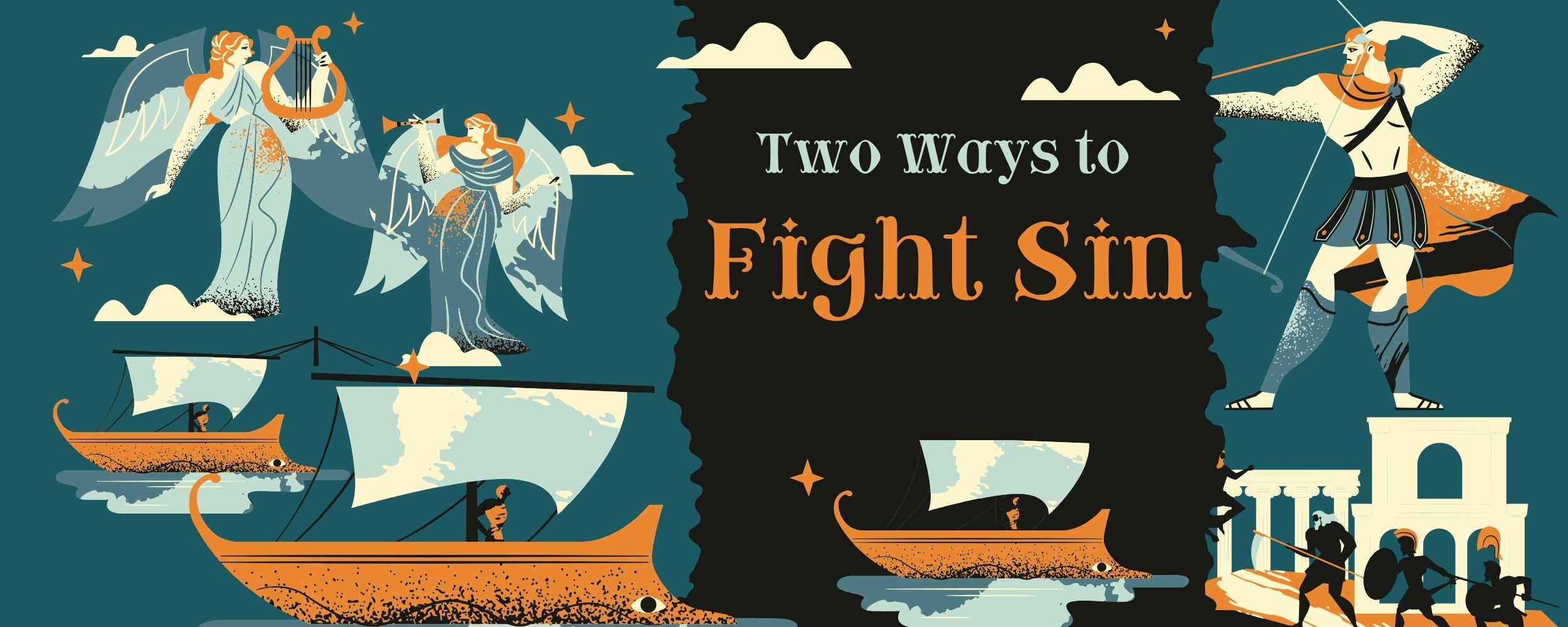
Two Ways to Fight Sin

Friday Highlight – Two Ways to Fight Sin
I’ve loved Homer’s The Odyssey since I saw it on Wishbone in 1995. The historical and literary accuracy of that interpretation notwithstanding, the story captivated me from a young age, and I’ve now got it in several different translations. If you haven’t been swept up in the fervor that followed Christopher Nolan’s recent rendition, The Odyssey is an ancient Greek adventure that follows a war hero named Odysseus as he tries to get home after winning the Trojan War. The journey is about 560 nautical miles, so even in ancient times it would only take a Greek ship about a week to make the trip, but due to forces beyond his control (and some that are very much in his control), it takes Odysseus ten years to return home.
One of his many perils is crossing paths with the mythical monsters called the Sirens. These creatures had the head of a woman and the body of a bird (the mermaid imagery didn’t pop up until the Middle Ages), and they sang a captivatingly beautiful song promising love, immortality, and infinite wisdom. Their song was so beautiful and alluring that no one could resist sailing to their island, but it was a trap: There were sharp rocks just beneath the waves, and if you sailed too close, you’d be shipwrecked and devoured by the Sirens. Only two times in Greek mythology does anyone survive a close encounter with them, and we can learn a lot from the strategies they use.
The first example is our hero Odysseus. Warned about the Sirens, he orders his men to firmly tie him to the ship’s mast with a strong rope, and then stuff beeswax into their ears so they can’t hear a thing. Odysseus hears the Sirens’ song, and he struggles and curses and begs his men to cut him loose, but they can’t hear him, so they don’t. They safely sail past the island and continue their voyage home.
The second example is another Greek hero named Orpheus. Orpheus was the greatest musician of all time, and with his magic lyre (a stringed instrument somewhere between a harp and a guitar), he could tame wild animals, stop rivers, and even make rocks dance. He was recruited by yet another Greek hero named Jason to join him and his Argonauts on an adventure sailing around the ancient world. When this crew heard the Sirens, they were enchanted and immediately began steering their ship toward the island and their doom. But Orpheus, hearing the music, instantly picks up his lyre and plays a better song. His superior music breaks the spell for the rest of the crew, they see the danger in listening to the Sirens’ song, and they steer away, safely continuing their voyage.
Years ago, I heard Timothy Keller point out the difference in their temptation-avoidance strategies, and it’s stuck with me ever since. Sin is like the Sirens: it sings a beautiful song, promising peace, comfort, pleasure, joy, satisfaction, and every good thing, but it lies. Sin doesn’t actually want what’s best for you. It wants to drag you back into slavery, to shipwreck your faith. When Christ sets you free from slavery to sin, he enables and empowers you to resist its song, and we can employ strategies to resist sin like Odysseus, or like Orpheus.
The Odysseus Strategy
Like Odysseus, we can block our ears and “tie ourselves to the mast” to avoid sin, but it’s fragile. If even one sailor removes his wax, the whole plan falls apart and the crew perishes. I call this “mechanical resistance” because it involves the visible, physical interruptions of sinful patterns. It would look like getting up and walking away from temptation, installing site-trackers on your phone, getting rid of devices or apps that lead you into sin, sharing your location with a trusted accountability partner, or whatever else helps you physically resist situations that could lead you into sin.
The Orpheus Strategy
The second strategy is what the Argonauts use: They listen to a better song. I call this “affective resistance” because it has to do with the affections and desires. Jesus didn’t leave us alone in this world, he sent the Holy Spirit, the Spirit of Truth, to guide us and protect us (John 16:13). The more you keep in step with the Holy Spirit, the more you’ll know and love his voice, and the better you’ll be at distinguishing truth from lies, sin from righteousness, desires of the flesh from those of the Spirit (Galatians 5:16-25). We all desire beauty, acceptance, love, freedom, and joy, but sin can’t offer the real thing; all it offers is a counterfeit. The real thing is only found in God, so the more we know him, the easier it is to spot the fakes.
Both strategies are helpful, but the Odysseus strategy is more fragile and less sustainable because it relies on expected patterns (Odysseus had to know ahead of time that he would face the Sirens) and can crumble if even one part of the plan fails. The Orpheus strategy is much more flexible and adaptable, but it takes time to cultivate. You have to learn to love God more than the fleeting pleasures of sin. You have to learn to recognize the voice of Jesus (John 10:27). The best path forward is a combination of the two: Study your sin, identify its patterns, and interrupt those patterns. But also spend time in God’s Word, draw close to him, ask for help in cultivating Godward affections, learn to listen to the better song. It takes time and intentionality, but it’s so completely worth it.
Regardless of how you resist, your efforts to resist sin should never be rooted in your own strength. It’s God who gives the victory (1 Corinthians 15:57), and we’ll only be successful to the degree that we rely on him. He is faithful, he is good, and we can trust him.
1 Corinthians 10:13 – No temptation has overtaken you that is not common to man. God is faithful, and he will not let you be tempted beyond your ability, but with the temptation he will also provide the way of escape, that you may be able to endure it.